
AI in content marketing has gone from experiment to everyday tool in just three years.. If you’ve felt like your content marketing is working harder than ever and delivering less than it used to, you’re not imagining it — and you’re not alone. A major new survey of over a thousand content marketers just confirmed it in hard numbers, and the reason behind it isn’t the one most people assume.
The Numbers, Plainly
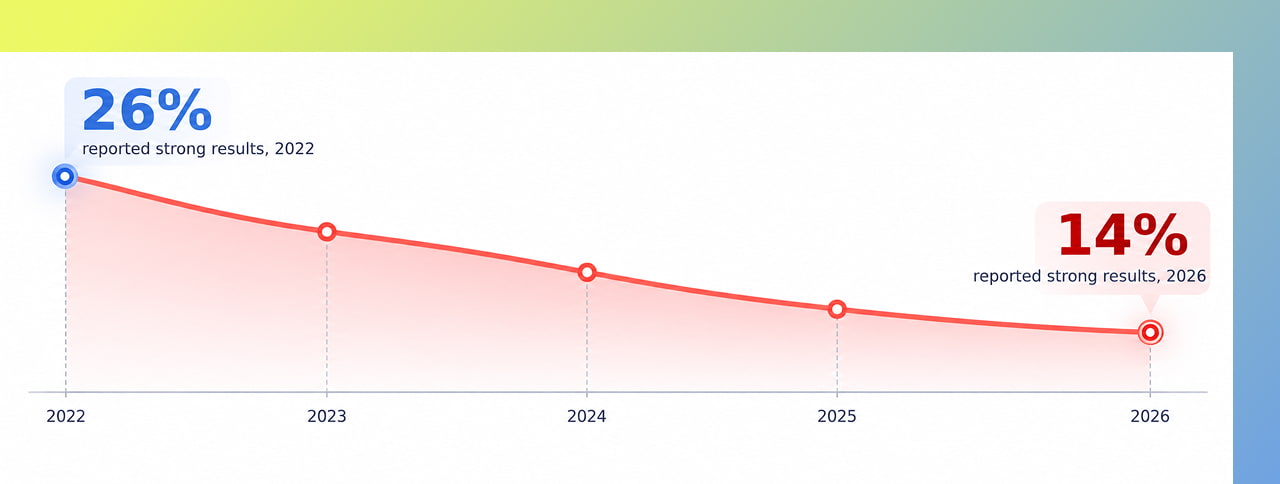
Every year, Orbit Media surveys more than a thousand content marketers about what they create, how they work, and whether it’s actually paying off. Their 2026 results, published this September, are stark: only 14% of marketers now report “strong results” from their content. That’s the lowest figure in the survey’s 12-year history — down from 26% as recently as 2022.
Here’s the part that makes the finding genuinely interesting rather than just discouraging: this drop happened in the exact same year that AI adoption among these same marketers hit 92.4% — an all-time high. Nearly every marketer surveyed is now using AI. Results, meanwhile, went the opposite direction. Google’s own guide to helpful content asks the same question: does a page offer original information, research or analysis?
Is AI in Content Marketing the Problem?
This is where it would be easy to draw the wrong conclusion, and it’s worth being precise about what the data actually shows. The survey’s own analysis is direct: the decline tracks with marketers abandoning practices historically linked to strong results — not with AI adoption itself. Using AI didn’t statistically predict worse results. What predicted worse results was doing less of the specific, effortful work that used to reliably produce good content.
Practices that became measurably less common over the past year include:
- Working with outside experts and influencers
- Conducting original research
- Doing keyword research before publishing
- Promoting content through paid channels
- Formal human editing
- Consistent use of analytics to guide decisions
Guest blogging saw the steepest single decline, down 29% year over year, with influencer collaboration close behind at a 22% drop.
The One Stat That Should Change How You Think About This
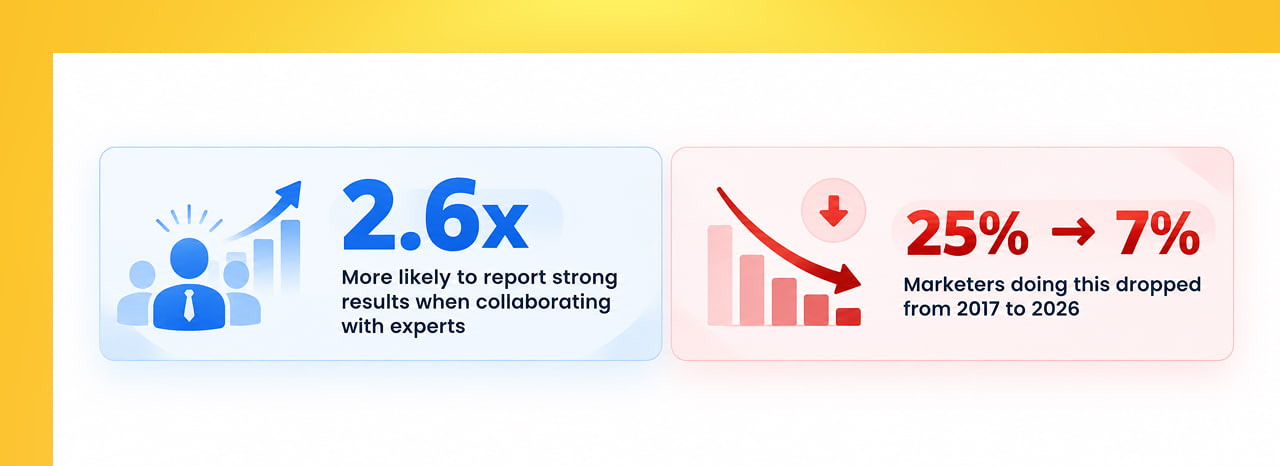
Buried in the data is a number that deserves far more attention than it’s getting: marketers who regularly collaborated with outside experts were 2.6 times more likely than the benchmark to report strong results. And yet adoption of that exact practice fell from 25% of marketers in 2017 to just 7% today.
In other words, the single practice most strongly linked to success is also one of the practices marketers have most aggressively cut. That’s not a coincidence worth shrugging off — it’s close to a direct explanation for the 12-year low.
Why This Happened
None of this is really mysterious once you look at it directly. AI made it dramatically faster to produce a draft. The average blog post now takes about 3 hours and 20 minutes to write, down from over 4 hours in 2022 — a real, measurable time saving. But speed on the writing step doesn’t replace the slower, harder work that actually made content good in the first place: finding real experts to interview, running original research, doing the unglamorous keyword homework, and paying someone to promote what you made.
Ann Handley, chief content officer at MarketingProfs, called the findings a wake-up call, urging marketers to get “much more discerning about which effort we remove, and which we keep.” That framing matters. The problem was never AI adoption itself — it’s what marketers let AI quietly replace along the way.
What This Means for Your Content Strategy
- Don’t cut the practices proven to correlate with results, even when they’re the slowest ones. Original research and expert collaboration remain some of the strongest predictors of success in the data — cutting them to save time is cutting exactly the wrong corner.
- Use AI for speed on the parts that were always mechanical, like first drafts and formatting, and protect the human time that goes into original insight, real sourcing, and editing.
- Keyword research still matters. The survey specifically found marketers who did it were more likely to report strong results, directly challenging the idea that SEO fundamentals stopped mattering in the AI era.
- Treat editing as non-negotiable, not a step to skip when a draft already “reads fine.” Formal human editing was one of the practices most closely tied to stronger outcomes.
If your content strategy has quietly shifted toward faster, thinner content over the past year or two, this data is a useful prompt to check what got cut along the way — and whether it’s worth bringing back.
Quick Takeaways
- A 2026 survey of over 1,000 content marketers found just 14% report “strong results” from their content — a 12-year low, down from 26% in 2022.
- This drop happened during the same period AI adoption hit an all-time high of 92.4%, but the research found no link between using AI and getting better results.
- The decline tracks closely with marketers cutting original research, expert collaboration, keyword research, paid promotion, and formal editing.
- Marketers who regularly collaborate with outside experts are 2.6 times more likely to report strong results — yet that practice has fallen from 25% adoption in 2017 to just 7% today.
- The fix isn’t abandoning AI — it’s making sure AI replaces mechanical work, not the harder, proven practices behind genuinely good content.
Want a Content Strategy That Uses AI Without Losing What Actually Works?
Speed and quality don’t have to trade off against each other when they’re balanced deliberately. Reach out through our contact form and we’ll help you build a content approach that keeps the practices the data says actually work.