

Semantic SEO is no longer a side tactic for content teams. It has become the foundation for ranking in an AI-driven search environment where search engines interpret intent, entities, relationships, and topical depth instead of relying only on exact-match keywords.
For brands that want sustainable organic growth, the shift is clear: content must be created for understanding, not just indexing. That means covering a topic comprehensively, structuring information clearly, and guiding users toward the next logical action with relevant service and blog pathways.
Why semantic SEO matters now
Search behavior is becoming more conversational, more specific, and more influenced by AI-generated experiences. Google processes over 8.5 billion searches per day, and more than one-third of searches are long-tail queries with four or more words, which reflects how people increasingly search in natural language rather than with short, fragmented phrases.
The rise of AI-enhanced results reinforces this shift. Industry reporting shows that AI Overviews appear in a meaningful share of Google searches, especially for informational and problem-solving queries, while a Statista study found that 25% of adults using AI-powered search engines said the results felt more specific to their searches and 12% said they trusted those results more. When users expect context-rich answers, websites need pages that demonstrate context-rich relevance.
That is exactly what semantic SEO is designed to achieve. Instead of optimizing one page for one keyword, semantic SEO helps search engines understand a full topic ecosystem: what your page is about, how it connects to related concepts, and why your brand deserves visibility for adjacent queries too.
What semantic SEO actually means
Semantic SEO is the practice of building content around topics, entities, and search intent rather than just repeating a target keyword. It uses related terms, supporting subtopics, internal links, content hierarchy, and structured formatting to show search engines that a page answers a subject comprehensively.
In simple terms, a page about SEO should not stop at defining SEO. It should naturally cover search intent, on-page signals, content depth, internal linking, technical clarity, and conversion pathways because that is how users explore the topic and how modern algorithms evaluate relevance. This is one reason businesses increasingly pair content strategy with broader digital marketing services that align traffic generation, lead quality, and conversion goals.
Semantic SEO also supports stronger site architecture. When a website connects blog content with relevant commercial pages such as Search Engine Optimization, Website Development, and Social Media Marketing, it becomes easier for both users and crawlers to understand the brand’s expertise and move from awareness to inquiry.
The ranking framework behind semantic SEO
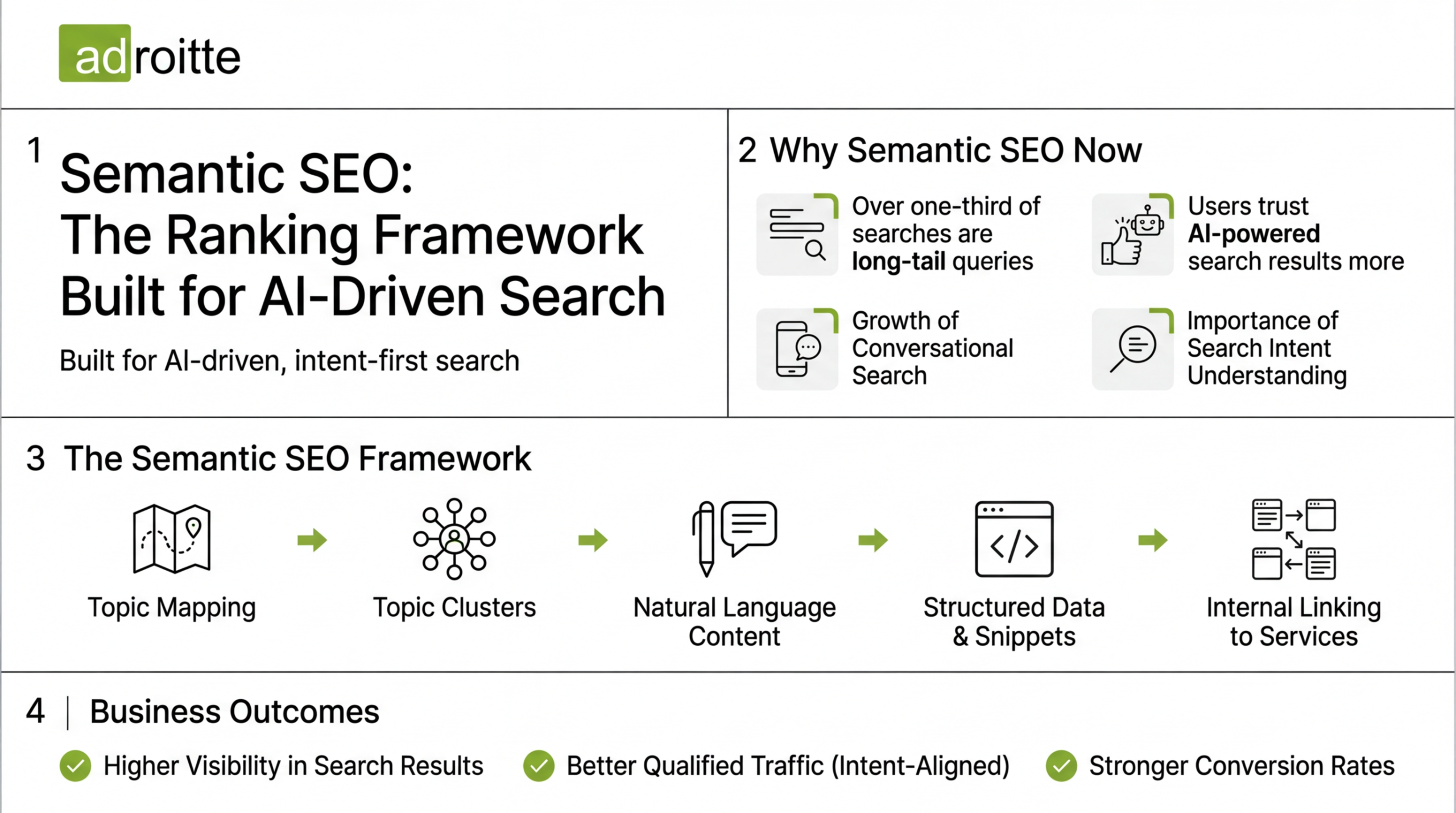
A strong semantic SEO framework starts with topic mapping. Instead of beginning with one high-volume keyword, the better approach is to identify the main subject, the user problems around it, and the related entities that define the topic space. For example, if the core topic is semantic SEO, the connected concepts may include search intent, entity optimization, schema markup, topical authority, internal links, and AI Overviews.
The next layer is topic clustering. A well-built site uses pillar pages for broad commercial themes and supporting blogs for detailed informational queries. On Adroitte’s site, service-led themes such as digital marketing, SEO, web development, PPC, and website maintenance create natural cluster anchors for content that educates users while supporting lead generation.
Internal linking is a critical part of this framework. Informational articles should link to closely related service pages where the commercial solution becomes the next step, while service pages should also connect to educational resources that build trust and topical depth. For example, a blog discussing semantic SEO can naturally point readers to digital marketing services for strategic support, to Adroitte’s perspective on on-page SEO techniques for implementation details, and to adjacent services like web design or maintenance when site performance and UX affect search outcomes.
Language optimization is another major layer. Around 34.71% of Google searches contain four or more words, which means pages optimized only for short, exact-match terms miss a large share of real-world search behavior. Semantic content performs better when headings reflect user questions, body copy uses natural variations, and each section resolves a specific intent instead of padding the page with repetition.
Formatting matters too. Featured snippets can earn click-through rates as high as 42.9%, making structured answers, definition paragraphs, lists, and FAQ-style formatting especially valuable for visibility. This is why semantic SEO is not only a writing exercise; it is a content design system built for both readers and search engines.
How AI-driven search changes content strategy

AI-driven search rewards pages that reduce ambiguity. Search systems increasingly compare multiple sources, extract concise answers, and look for content that demonstrates authority across a subject instead of answering only one narrow phrase. Thin pages written around slight keyword variations are less useful in that environment because they often fail to add information gain.
This has practical implications for content teams. Articles should answer the core query early, expand into related subtopics, include examples where useful, and create smooth transitions to the next relevant page on the site. For businesses investing in growth, this also means SEO cannot operate in isolation from UX, analytics, paid visibility, or conversion optimization, which is why integrated digital marketing strategies are often more effective than disconnected tactics.
AI-driven search also raises the standard for expertise signals. Adroitte highlights a 10+ year track record in digital marketing and describes end-to-end support across SEO, PPC, website development, social media marketing, and maintenance, which are the kinds of connected capabilities that strengthen topic authority across a site. When content and service pages reinforce one another, search engines gain a clearer picture of domain expertise.
Building a semantic SEO content model that converts
The best semantic SEO strategies are not built only to rank. They are built to rank and convert. That starts with understanding where each piece of content sits in the buyer journey.
A top-of-funnel blog should educate and expand the topic. A middle-of-funnel page should compare options, explain methods, or remove objections. A bottom-of-funnel service page should clearly communicate outcomes, process, and trust signals. When these assets are connected properly, users can move naturally from learning about semantic SEO to exploring digital marketing services, reviewing broader solutions on the main services website, or reading supporting content such as best on-page SEO techniques.
This approach also improves measurement. Adroitte emphasizes ROI, conversion-focused design, and strategic optimization as core parts of digital marketing delivery. That aligns closely with semantic SEO because better query matching, clearer page relationships, and stronger user journeys typically produce more qualified traffic rather than just higher traffic.
Semantic SEO is the ranking framework built for how search works now. As AI-driven search continues to prioritize intent, entity relationships, topical authority, and structured answers, brands that still rely on isolated keywords and thin content will struggle to remain competitive.
Businesses that invest in topic-driven content, strong internal linking, service-to-blog alignment, and conversion-aware site architecture put themselves in a stronger position to earn both visibility and trust. In that sense, semantic SEO is not a content trend. It is the operational model for modern organic growth.
Ready to align your content with how modern search engines actually understand context? Reach out through our contact form and we’ll get back to you promptly. Let’s build a semantic SEO strategy that strengthens relevance, improves visibility in AI-driven search, and drives sustainable organic growth.