

AI website builders can now generate a full layout, on-brand copy, images, and basic SEO from a one-line prompt in a matter of minutes. That’s a genuinely useful trick for getting something live fast. But “AI can produce a website” and “AI can produce the website your business actually needs” are very different claims, and the gap between them is bigger than the marketing around these tools suggests. If you’re weighing AI against a professionally built site, Adroitte’s website development services and website design services are worth talking to first. A short conversation about what your site actually needs to do will tell you far more than any AI demo will. Here’s a more honest look at what these tools get right, and the much longer list of what they get wrong.
How AI Website Building Actually Works
Most AI website builders follow a similar pattern: you answer a short set of questions about your business — industry, goals, tone, existing branding — or type a prompt describing what you do. The AI then generates a first draft: page structure, headline copy, body text, a color palette, and stock or AI-generated imagery. From there, you edit the draft using a visual editor.
It’s worth being clear about what this actually is: a templated starting point assembled from patterns the AI has seen before, not a considered design decision made with your business, your customers, or your competitors in mind. That distinction matters more than the speed of the output suggests.
What AI Gets Right — With Real Limits Attached
Speed. The first draft takes minutes instead of days. That’s real, but a fast first draft isn’t the same as a finished, effective website — it’s closer to a rough sketch than a launch-ready site, and the gap between the two is usually underestimated.
Cost. AI builders bundle hosting, design, and copywriting into a low monthly fee. This looks cheap upfront, but it’s cheap because you’re doing the editing, quality control, and strategic thinking yourself — work that a professional would otherwise handle, and that has a real cost even if it isn’t itemized on an invoice.
Passable drafts for the simplest sites. For a business that just needs a name, an address, and a phone number online, an AI builder can produce something adequate. That’s a narrow use case, though — most businesses actually competing for customers online need more than a digital business card.
Basic technical SEO. Meta tags, sitemaps, and mobile responsiveness get handled automatically. This is table stakes, not an advantage — every competent website, AI-built or not, should have these basics covered. It shouldn’t be mistaken for an SEO strategy.
Where AI Falls Short — And This Is the Bigger List
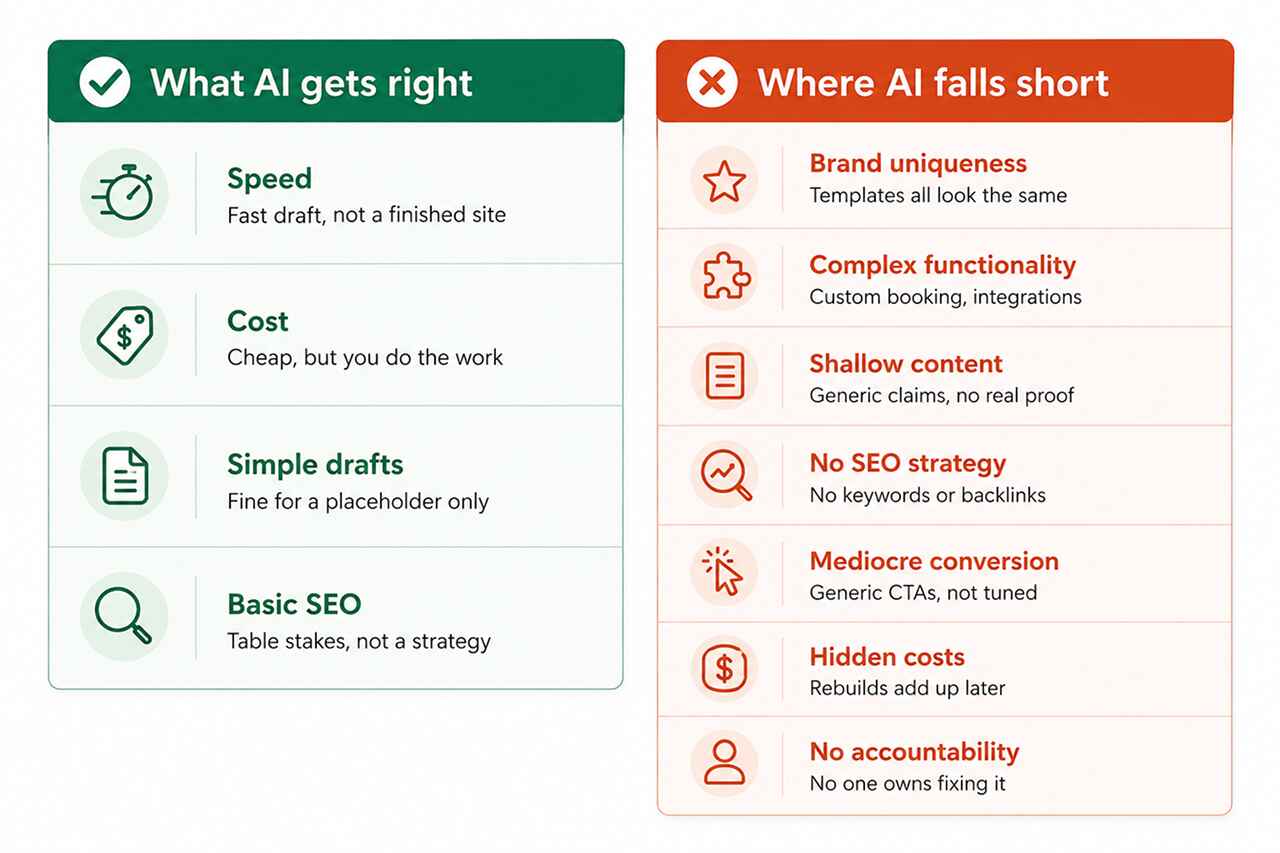
Brand uniqueness. AI-generated sites are assembled from templates and pattern libraries. Even a strong-looking output tends to converge on the same layouts, the same stock-photo aesthetic, and the same “confident, professional” copy tone as every other business that used the same tool. If your competitors are also using AI builders, you may end up looking indistinguishable from them at exactly the moment you need to stand out.
Complex functionality. Custom booking logic, quoting tools, integrations with your CRM or inventory system, membership areas — anything outside a standard template pattern is largely outside what these tools can do well. Most real businesses hit this ceiling faster than they expect, often after they’ve already invested time building out the “simple” version.
Content that’s shallow and occasionally wrong. AI-generated copy is a first draft, not finished writing. It routinely includes generic claims with no real substance behind them, and it has no knowledge of your actual clients, your real differentiators, or the specific things that make people trust your business over a competitor’s. Left unedited, this content can actively undersell a good business.
No real SEO strategy. Technical SEO checkboxes are not the same as ranking. AI builders don’t do keyword research, don’t build backlinks, and don’t develop the ongoing content strategy that determines whether a site is found at all. A technically clean AI site with no strategy behind it will often lose to a less polished competitor that has one.
Conversion performance is usually mediocre. Templates are built to look acceptable across thousands of businesses, not to convert visitors for your specific business and audience. Decisions like where the call to action sits, what objections need addressing on a service page, and how trust gets built before someone fills out a form are strategic choices — AI defaults to generic answers, not answers tuned to your customers.
Hidden long-term costs. A cheap AI site that needs to be substantially rebuilt in a year isn’t actually cheap — it’s a deferred cost, and often a larger one than building it properly the first time. Some platforms also lock your site into their own editor, which makes migrating to a developer later harder and more expensive than starting fresh would have been.
No accountability when something breaks. If an AI-generated site has a bug, a security issue, or simply stops converting, there’s no one whose job it is to notice and fix it. A development team is accountable for outcomes; a template generator is not.
The Leading AI Website Builders — and Their Real Ceiling
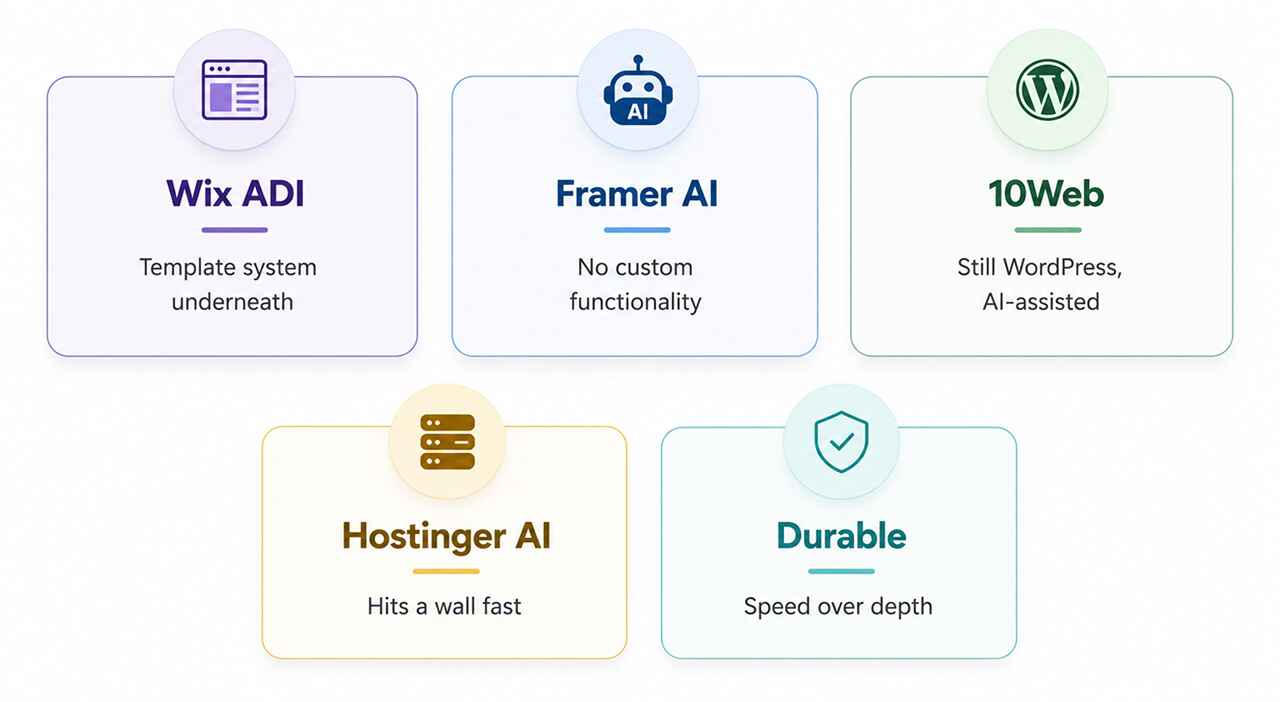
- Wix (ADI) — the most mature all-around option, but still a template system underneath; customization beyond its patterns is limited.
- Framer AI — the strongest on visual polish, though genuinely custom interactions and functionality still require a developer.
- 10Web — generates an actual WordPress site, which at least keeps a path open to real development work later.
- Hostinger AI Website Builder — the cheapest option, and it shows in how far you can push it before hitting a wall.
- Durable — the fastest to a live site, and correspondingly the shallowest; it’s built for speed, not depth.
Every one of these tools is optimized to demo well, not to be the last website your business ever needs.
When AI Is Actually Enough
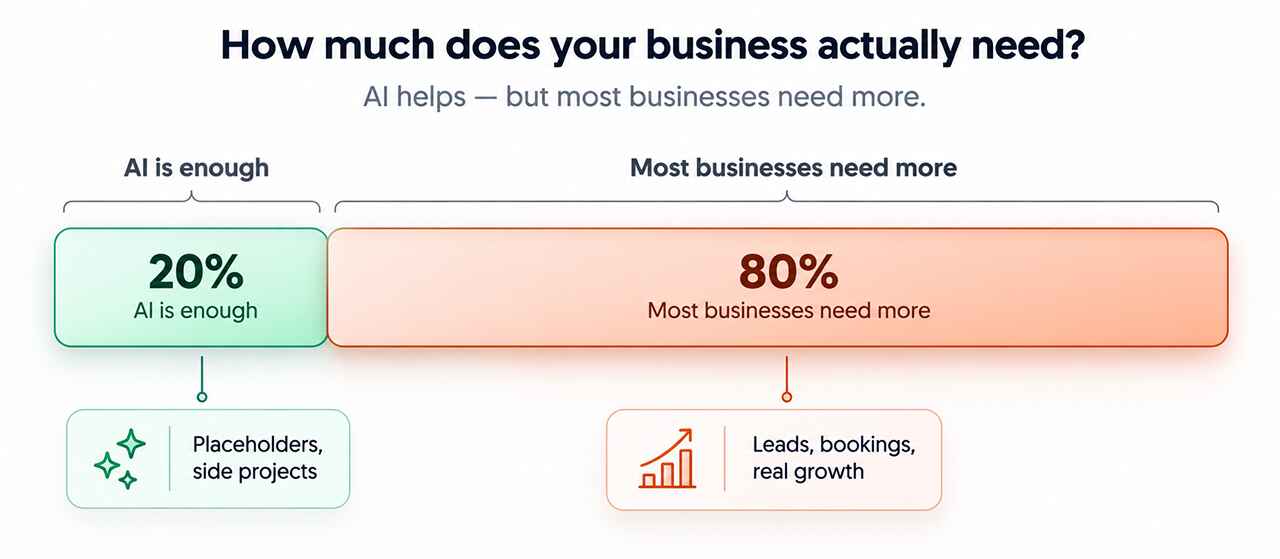
To be fair to the tools: AI is a reasonable choice for a very narrow slice of cases — a genuinely temporary placeholder, a side project with no real commercial stakes, or a business that truly only needs a name and phone number online with no expectation of the site generating leads. Outside of that narrow band, “unless you need something customized” is doing a lot of work in that sentence, because most businesses that depend on their website for leads or sales do need something customized: a booking flow that matches how they actually work, content that reflects real expertise, and an SEO strategy aimed at their specific market. That’s the majority case, not the exception.
The Honest Answer
AI can produce something that looks like a website very quickly and very cheaply. It’s considerably worse at producing a website that’s uniquely yours, that ranks, that converts, and that someone is accountable for maintaining. For most businesses serious about using their website as a growth channel rather than a digital placeholder, AI is best treated as a rough first draft at most — not a replacement for a developer, and not a decision to make without weighing what it’s likely to cost you later in rebuilding, lost leads, and lost search visibility.
If you’re deciding between an AI shortcut and doing it properly, Adroitte’s website development and website design teams can tell you honestly which one your business actually needs.