

Some of the best brands stay invisible in search not because their content is bad, but because technical issues quietly choke their visibility behind the scenes. These “silent SEO killers” block crawlers, slow pages down, confuse indexation, and waste the authority you worked hard to earn.
Why Great Content Still Fails to Rank
If you have strong content, a solid brand, and good reviews, but organic traffic is flat, it is usually not “just the algorithm.” More often, it is one or more technical blockers that:
- Prevent search engines from crawling or indexing key pages
- Slow your site enough that users bounce before engaging
- Break internal paths so authority never reaches the pages that matter
Technical SEO rarely gets the spotlight on social media, but it decides whether your content even gets a chance to compete.
Silent Killer #1: Crawl and Indexing Problems
If search engines cannot reliably crawl and index your pages, nothing else matters. Google Search Console helps identify crawl errors and indexing issues caused by SEO killers.
Common hidden issues include:
- Accidental noindex tags on important pages
- Misconfigured robots.txt that blocks critical sections or assets
- Missing or broken XML sitemaps so new URLs are hard to discover
- Canonical chaos where multiple URL versions compete with each other
Technical guides consistently list “site isn’t indexed correctly” and “meta robots noindex set” among the top SEO issues holding back visibility.
Quick checks:
- Verify important URLs are indexable (no noindex and allowed in robots.txt)
- Make sure there is a clean, up to date XML sitemap submitted in Search Console
- Check you do not have duplicate homepages (with/without trailing slash, HTTP vs HTTPS, www vs non www)
When indexing is fixed, brands often see “invisible” content start appearing for dozens of long tail queries without touching the copy.
Silent Killer #2: Slow, “Heavy” Pages
Speed is one of the most common and underestimated SEO killers. Slow pages frustrate users, increase bounce rates, and send negative signals to search engines.
Regular offenders include:
- Oversized images and background videos uploaded at raw size
- Too many scripts, tags, and plugins firing on every page
- Bloated themes and page builders injecting unnecessary code
- Weak hosting struggling under real traffic
Technical SEO audits repeatedly highlight slow Core Web Vitals as a major reason why otherwise strong pages fail to reach top positions.
Fixes to prioritize:
- Compress and convert images (e.g., WebP), lazy load offscreen media
- Remove unused plugins, scripts, and third party trackers
- Minify CSS and JavaScript, enable Gzip/Brotli compression, use a CDN
- Move to stable, performance oriented hosting
Even modest improvements in load time can unlock better engagement and more stable rankings.

Silent Killer #3: Mobile Experience Issues
With mobile first indexing, your mobile experience is effectively your main website as far as search engines are concerned.
Hidden mobile problems include:
- Content missing or hidden on mobile that exists on desktop
- Tiny tap targets, overlapping buttons, or intrusive interstitials
- Layouts that break on smaller viewports
Technical SEO resources consistently list mobile usability issues as a core category of ranking problems.
Practical steps:
- Use responsive design and test key templates on real devices
- Keep critical content visible on mobile (no “desktop only” sections)
- Fix CLS (cumulative layout shift) so elements stop jumping around
A clean mobile experience improves both user satisfaction and the signals search engines see in your analytics.
Silent Killer #4: Broken Links and Orphaned Pages
Broken internal links and orphan pages silently waste crawl budget and authority. A surprising number of “great” brands have:
- Important pages only accessible through search or direct URL
- Old URLs returning 404s instead of helpful redirects
- Internal links pointing at redirected or deleted pages
Technical audits frequently list broken links and weak internal linking among the most damaging but fixable SEO issues.
What to do:
- Run a crawl to find 404 pages and fix or redirect them
- Update internal links that point to redirected or outdated URLs
- Identify orphan pages (no internal links in) and connect them from relevant content
Cleaning this up often produces quick wins, as authority finally flows where it should.
Silent Killer #5: Duplicate and Confusing Signals
Search engines struggle when they see multiple versions of similar content with no clear preferred URL. This might happen because of:
- Missing or misconfigured canonical tags
- Multiple URL variants (with parameters, trailing slashes, HTTP/HTTPS)
- CMS archives, tags, and pagination creating thin duplicates
Research on technical SEO issues shows that better canonicalization and duplicate content handling alone can recover a significant share of lost organic traffic.
Key actions:
- Choose a single canonical version for each important page
- Use canonical tags correctly on duplicates and variants
- Avoid creating unnecessary low value URL variations
The goal is to give search engines one strong, consolidated version of each piece of content.
Silent Killer #6: Weak Structured Data and Metadata
Great brands often publish strong content without giving search engines enough context to understand it.
Common missed opportunities:
- No structured data (schema) on articles, products, FAQs, or events
- Missing or generic meta descriptions that fail to win clicks
- Inconsistent title tags that do not reflect page purpose
Technical SEO guides emphasize that while schema is not a direct ranking factor, it strongly influences how pages appear and how often users click them.
Improvements that help quickly:
- Add JSON LD schema appropriate to each page type (Article, Product, FAQ, Organization, etc.)
- Write clear meta descriptions that echo search intent and include a call to action
- Standardize title formats so users and crawlers can predict what they will get
Better presentation in the SERP improves CTR, which indirectly supports rankings over time.
Silent Killer #7: Content and Intent Misalignment (Disguised as Technical)
Sometimes the “technical” issue is that the page structure does not match what users and algorithms expect for that query. Even a fast, crawlable, perfectly marked up page can underperform if:
- The content type does not match intent (blog post where people expect a comparison, or sales page where they expect a guide)
- The main question is buried under brand centric copy
- There is nothing unique compared with existing top results
Industry experts repeatedly note that “content quality is fine, but doesn’t match search intent” as a top reason pages do not rank, even when everything looks optimized.
How to spot and fix this:
- Compare your page layout with the top 5 results for the same query
- Check whether the dominant format is guides, lists, tools, product pages, or comparison pages
- Restructure your page to better match intent while keeping your unique angle
This blend of structural and content alignment is often the missing piece for established brands.
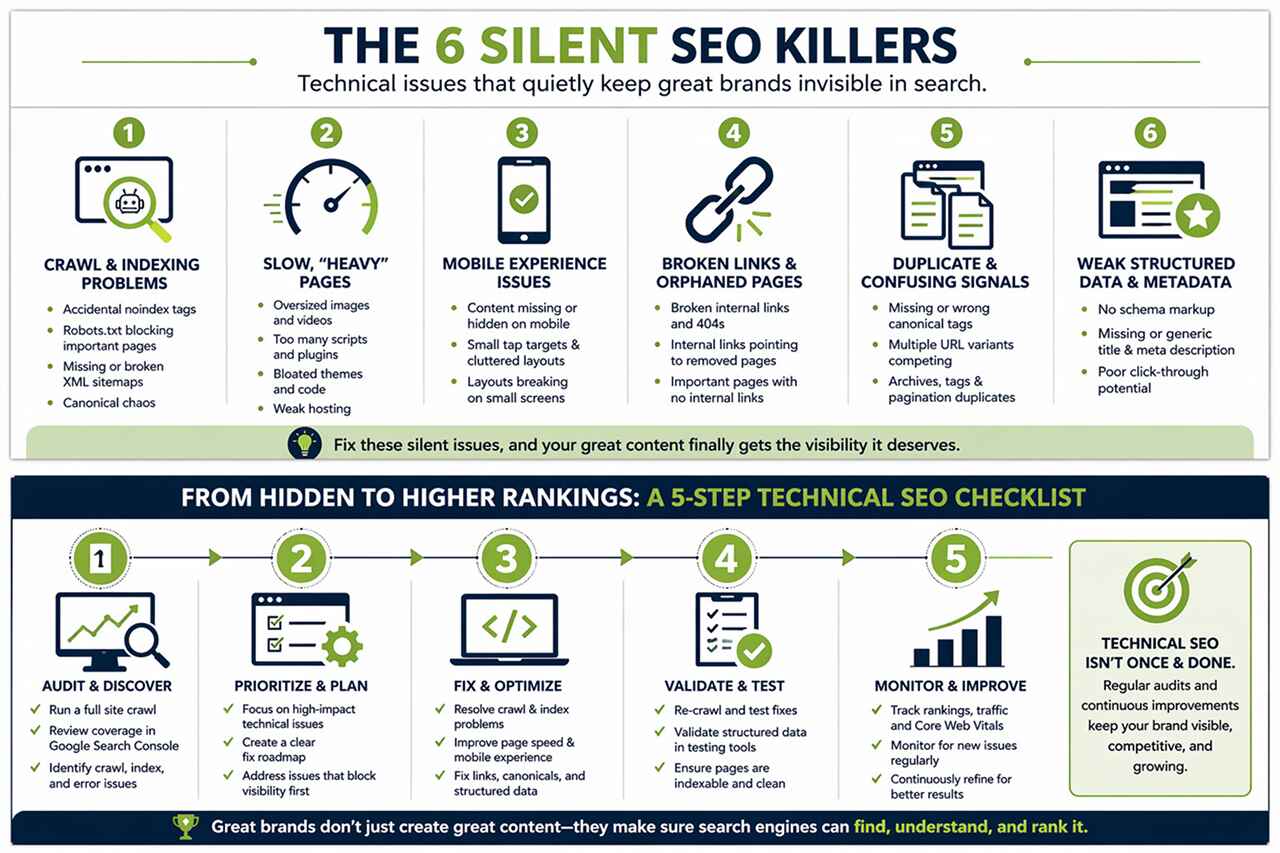
How to Systematically Find Your Silent SEO Killers
Rather than guessing, use a simple pattern:
- Run a full technical crawl with your preferred tool
- Group issues into: crawl/indexing, speed, mobile, internal links, duplication, schema/metadata
- Prioritize by impact: start with anything that blocks indexing or affects large parts of the site
- Fix in sprints, then measure changes in impressions, clicks, and average positions
Lists of common technical SEO issues are long, but the majority of impact usually comes from a handful of recurring problems.
FAQ: Silent Technical SEO Killers
How do I know if technical issues are my main problem?
If you have high quality content, a strong brand, and good engagement in other channels but very low impressions or indexing issues in Search Console, technical SEO is a likely culprit.
Can I fix technical SEO once and forget about it?
No. Platforms, plugins, and site structures change, so new issues appear over time. Regular technical SEO audits (at least quarterly) are essential to catch new silent killers early.
Do I need a developer to fix these problems?
Some fixes (like compressing images or updating meta tags) can be handled in house, but deeper issues—like crawl budget waste, canonicalization, or complex JS rendering—often require a developer or technical SEO specialist.
If you tell me which CMS you are using (WordPress, Shopify, custom, etc.), a platform specific technical checklist can be outlined that you can plug into your next SEO audit.
Is your website losing visibility because of hidden technical issues? Reach out through our contact form and we’ll respond promptly. Let’s uncover the silent SEO killers holding your brand back and build a stronger technical foundation for lasting search performance.