When Adobe Inc. confirmed its $1.9 billion acquisition of Semrush, it wasn’t just another software deal making headlines.
At a time when artificial intelligence is rapidly reshaping how people discover brands online, this move reflects something much bigger — a shift in how visibility itself is defined in digital marketing.
For years, businesses have depended on search engines to bring in traffic. Today, that journey is changing. People are no longer just typing queries into Google; they are asking AI tools for answers, recommendations, and comparisons. In that environment, being “ranked” is no longer enough — brands need to be selected.
This is the backdrop against which Adobe’s acquisition of Semrush needs to be understood.
A Deal That Goes Beyond SEO
Semrush built its reputation as a powerful Search Engine Optimization and competitive intelligence platform. Marketers have relied on it for keyword research, competitor tracking, and content optimization.
But reducing this acquisition to “Adobe buying an SEO tool” misses the point.
Over the past few years, Semrush has expanded into:
- Content intelligence
- Market analysis
- Online visibility tracking beyond traditional search
At the same time, Adobe has been steadily building an ecosystem that already includes creative tools, analytics, and customer experience platforms.
By bringing Semrush into that ecosystem, Adobe is effectively connecting content creation, optimization, and performance tracking into a single loop.
Instead of marketers juggling multiple disconnected tools, this integration aims to centralize how brands:
- Create content
- Understand audiences
- Measure visibility
- Refine strategy
Why This Acquisition Is Happening Now
The timing of this deal is not accidental.
Digital behavior is changing quickly. Increasingly, users are interacting with AI systems that provide direct answers instead of lists of links. Whether it’s product recommendations, research summaries, or comparisons, AI is becoming the first touchpoint.
This shift creates a challenge for brands.
Earlier, visibility meant appearing on the first page of search results. Now, it means being part of the information AI systems rely on and present.
Adobe has openly acknowledged the rise of AI-driven discovery, especially in commerce and content consumption. As AI-generated recommendations grow, the need to understand and influence those outputs becomes critical.
Semrush provides exactly the kind of data and insight layer required to navigate this change.
Connecting Creation With Discovery
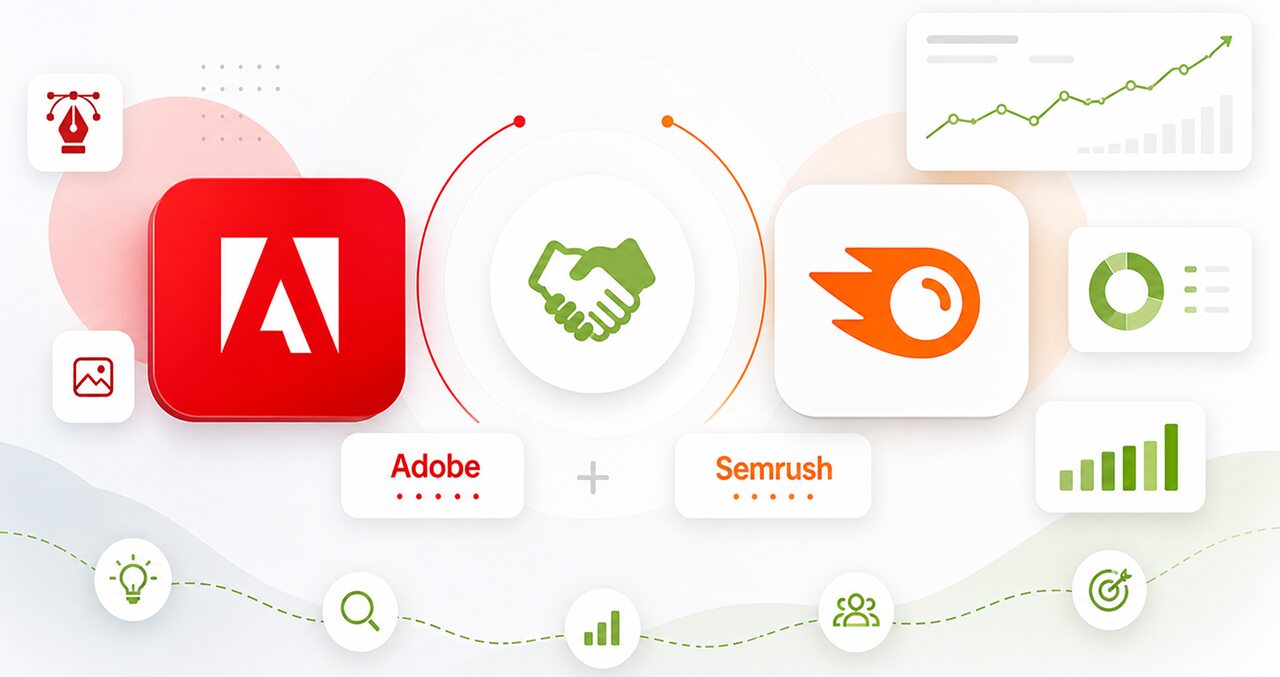
One of Adobe’s biggest strengths has always been content creation. Tools like Photoshop, Illustrator, and its broader Experience Cloud have made it a central player in how digital experiences are built.
However, creating content is only one part of the equation.
The real challenge lies in ensuring that content is:
- Discoverable
- Relevant
- Competitive in real time
This is where Semrush fits in.
With its data-driven insights, Adobe can now bridge the gap between what is created and how it performs in the real world. Instead of treating optimization as a separate step, it becomes part of the content lifecycle itself.
This kind of integration reflects a broader industry trend — moving from fragmented workflows to unified platforms.
What This Means for Marketers
For marketers, this deal highlights an important transition.
The focus is gradually shifting:
- From traffic volume → to visibility quality
- From keyword rankings → to contextual relevance
- From isolated campaigns → to continuous optimization
In practical terms, this means strategies will need to evolve.
Content can no longer be created purely for search engines. It needs to be structured, authoritative, and meaningful enough to be picked up and used by AI-driven systems.
At the same time, data will play a bigger role than ever. Understanding how competitors perform, how audiences search, and how content is interpreted across platforms will become essential.
A Broader Industry Signal
The Adobe–Semrush deal is also a signal to the wider market.
It suggests that:
- Marketing platforms are consolidating
- AI is becoming central to digital strategy
- Visibility is no longer limited to traditional search
Other companies in the space are likely to respond, either by expanding their capabilities or forming similar partnerships.
For businesses, this means one thing — the tools and strategies that worked even a few years ago may not be enough going forward.
Final Thoughts
This acquisition is not just about expanding Adobe’s product portfolio. It reflects a deeper shift in how digital presence is built and measured.
As AI continues to influence how people discover information, the definition of visibility is evolving. Being found is no longer about ranking higher — it’s about being relevant in the systems that shape user decisions.
Adobe’s move to bring Semrush into its ecosystem shows that the industry is already adapting to this new reality.
And for marketers, the message is clear:
understanding visibility in the age of AI is no longer optional — it’s essential.