

Website traffic continues to be one of the most closely monitored digital marketing metrics. Organic rankings, impressions, sessions, click-through rates, and visitor growth are frequently used to evaluate the success of SEO campaigns, paid advertising efforts, and content marketing initiatives.
Website traffic vs sales has become one of the most misunderstood topics in digital marketing. While increasing traffic is important, sustainable business growth depends on converting visitors into customers through effective user experiences, trust signals, and optimized conversion paths.
Higher traffic numbers are often interpreted as evidence of digital progress.
However, increased website traffic does not always translate into improved lead generation, customer acquisition, or revenue growth. Many businesses experience situations where website visits increase significantly while enquiries, conversions, and sales remain relatively unchanged.
This disconnect highlights an important reality of digital performance. While traffic acquisition remains essential, commercial outcomes are influenced by a broader set of factors that extend beyond visitor numbers.
Website traffic vs sales should be measured together to understand true marketing performance.
User experience, website performance, customer intent, trust signals, content relevance, and conversion optimization all contribute to determining whether visitors progress through the decision-making process.
Businesses investing in website development services increasingly recognize that improving the quality of the customer experience often delivers greater returns than focusing exclusively on traffic growth.
As digital competition continues to intensify, organizations are beginning to view website traffic as one performance indicator among many rather than the primary measure of online success.
Understanding Website Traffic vs Sales: Traffic Growth Does Not Always Translate into Revenue Growth
The relationship between traffic acquisition and revenue generation is often less direct than many businesses assume.
An increase in website visitors expands the potential customer base, but it does not automatically improve conversion performance. The commercial value of traffic depends largely on whether visitors find relevant information, trust the business, and encounter a user experience that supports decision-making.
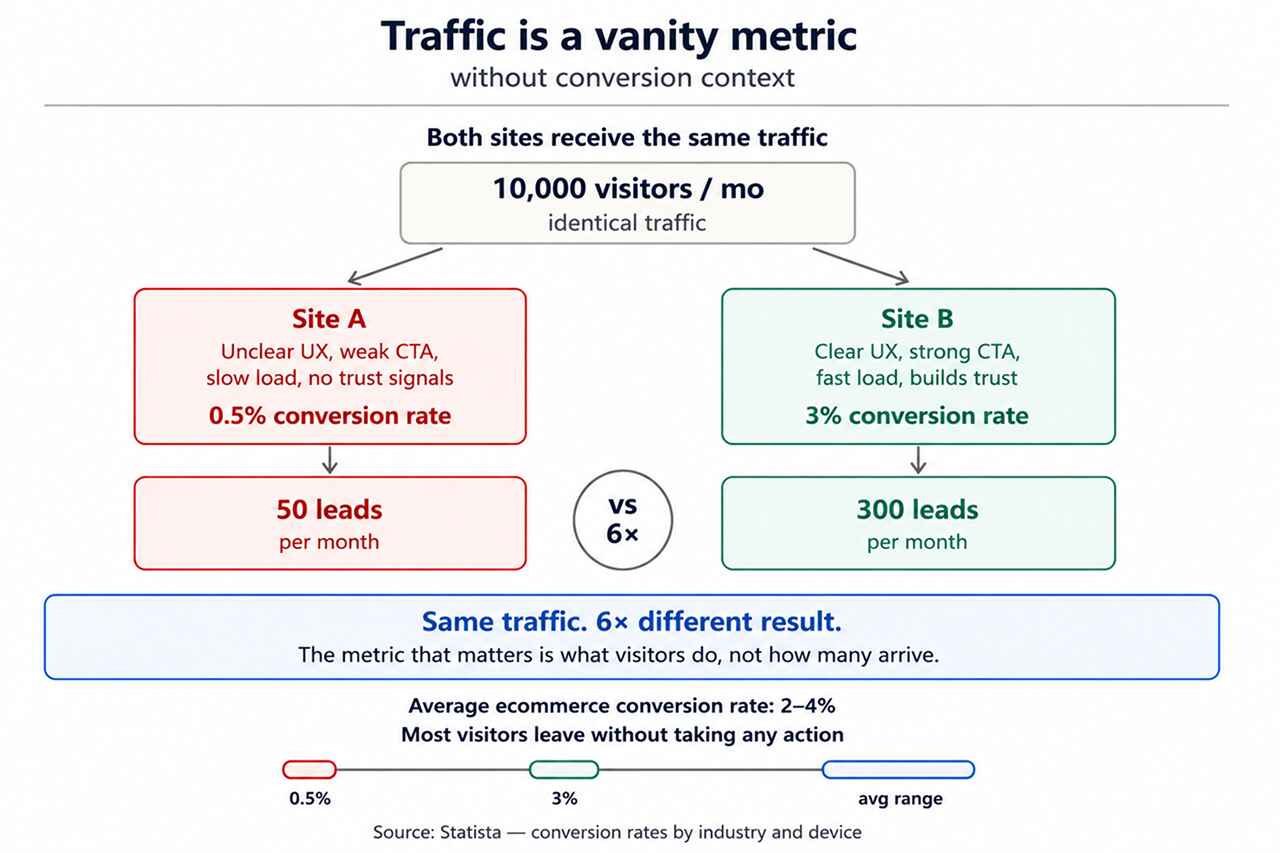
According to Statista, average ecommerce conversion rates typically range between two and four percent depending on industry and device type. This means that the majority of website visitors leave without completing a desired action.
Two organizations may attract similar traffic volumes while producing very different business outcomes. Differences in conversion rates often explain why one business generates substantially more enquiries or sales despite comparable visitor numbers.
Traffic growth should therefore be evaluated alongside conversion performance rather than as an isolated success metric.
The Gap Between Visitor Acquisition and Conversion Performance
Digital marketing strategies frequently emphasize attracting visitors through search engines, paid advertising, social media, and content marketing.
While these activities remain important, they represent only one stage of the customer journey.
Visitors arriving on a website evaluate numerous factors before taking action. They assess credibility, compare alternatives, review service information, evaluate pricing, and determine whether the business can meet their needs.
If the website fails to support these decision-making processes, increased traffic may contribute little to overall business performance.
Research from the Baymard Institute has consistently demonstrated that usability issues remain one of the leading causes of website abandonment. Difficult navigation, unclear messaging, and friction within the user experience often prevent visitors from progressing further.
This gap between acquisition and conversion explains why businesses can experience strong traffic growth without achieving corresponding improvements in commercial outcomes.
User Experience as a Driver of Commercial Outcomes
User experience increasingly influences both customer satisfaction and business performance.
Modern customers expect websites to provide clear information, intuitive navigation, responsive interfaces, and efficient customer journeys. When these expectations are not met, visitors frequently abandon websites regardless of how they arrived.
Research highlighted by the UX Design Institute notes that every dollar invested in user experience can generate significant returns through improved customer engagement and stronger conversion outcomes.
These findings reinforce the importance of viewing websites as customer experience platforms rather than simply digital marketing assets.
Businesses that invest in usability, content clarity, information architecture, and customer journeys often achieve stronger commercial performance without substantially increasing traffic volumes.
Website Performance and Its Influence on Customer Behavior
Website performance has become an increasingly important component of conversion optimization.
Customers expect websites to load quickly and function reliably regardless of device, browser, or connection speed. Performance issues create friction that can negatively affect engagement and reduce the likelihood of conversions.
Google’s Core Web Vitals framework emphasizes loading performance, responsiveness, and visual stability as important indicators of user experience.
Slow-loading pages, poor mobile experiences, and technical issues can reduce the effectiveness of marketing investments because visitors leave before meaningful engagement occurs.
Website performance should therefore be viewed not only as a technical consideration but also as a commercial factor that influences customer behavior.
The Role of Trust in Conversion Decisions
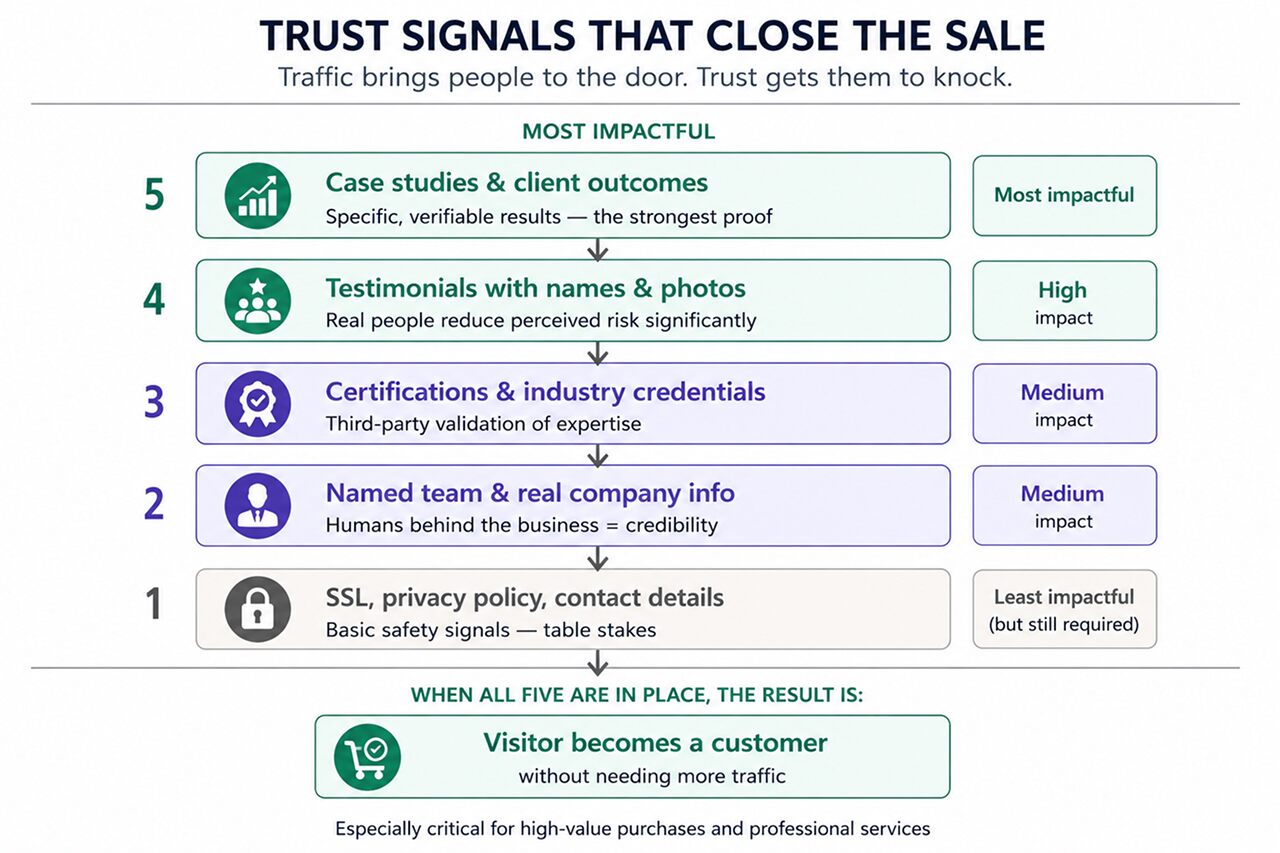
Traffic acquisition creates visibility, but trust influences decisions. Businesses that understand website traffic vs sales are more likely to achieve sustainable growth
Before submitting an enquiry, requesting a proposal, or completing a purchase, customers often seek evidence that a business is credible, experienced, and capable of delivering results.
Testimonials, case studies, certifications, reviews, project examples, and industry expertise all contribute to building confidence.
Businesses that invest heavily in traffic generation while neglecting trust-building elements may struggle to convert visitors into customers.
Trust signals become particularly important for professional services, high-value purchases, and complex buying decisions where customers require additional reassurance before taking action.
The ability to establish credibility frequently determines whether website visitors become customers.
Traffic Metrics Can Mask Underlying Performance Issues
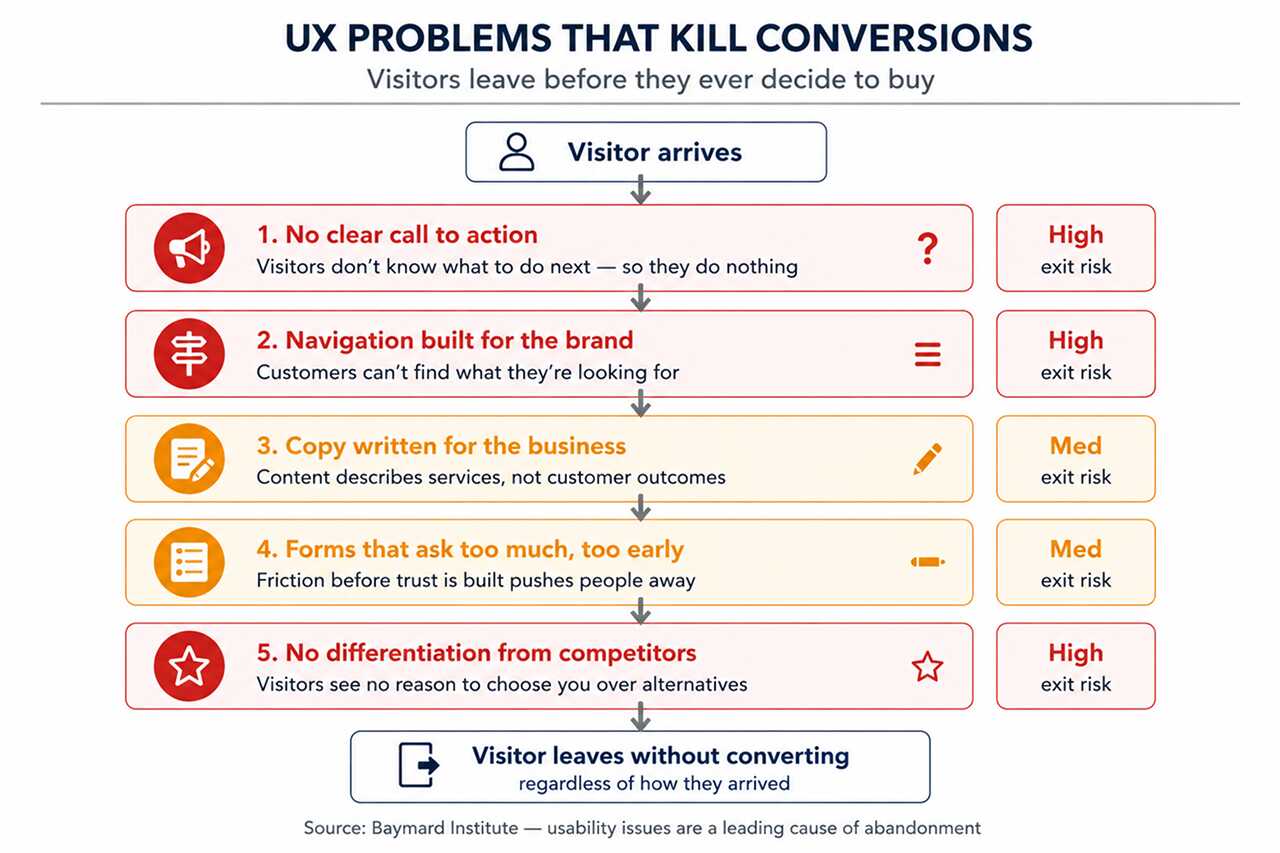
Increasing traffic numbers can sometimes create a misleading perception of success. Website traffic vs sales improves when websites provide clear calls to action and build customer trust.
Organizations may observe improvements in rankings, impressions, and sessions while overlooking problems affecting conversion performance. Website traffic vs sales optimization requires continuous testing and data-driven improvements.
Unclear value propositions, poor calls to action, weak messaging, complicated navigation, and inadequate customer journeys often remain hidden behind positive traffic reports.
Businesses that focus exclusively on acquisition metrics may fail to identify these underlying issues. Measuring website traffic vs sales helps organizations make more informed marketing decisions
The most effective performance evaluations combine traffic data with behavioral metrics such as engagement rates, conversion rates, customer journeys, and user interactions.
This broader perspective provides a more accurate understanding of website effectiveness.
Balancing Traffic Acquisition and Conversion Optimization
The highest-performing digital strategies balance traffic acquisition with conversion optimization. Improving website traffic vs sales requires optimizing both user experience and website performance.
Search visibility, content marketing, and paid advertising remain essential for attracting visitors. However, these activities produce greater value when supported by effective user experiences and conversion-focused websites.
Organizations increasingly recognize the importance of combining traffic generation with search engine optimization services that emphasize both visibility and user intent.
Websites that communicate value clearly, reduce friction, establish trust, and support decision-making frequently achieve stronger returns from existing traffic. Website traffic vs sales challenges often result from unclear messaging or poor navigation.
Improving conversion performance can often produce greater commercial impact than increasing visitor numbers alone. Businesses can strengthen website traffic vs sales outcomes by reducing friction throughout the buying process.
Rethinking Website Success Beyond Visitor Numbers
Website traffic remains an important performance metric. Businesses often focus on website traffic vs sales without identifying conversion barriers.
However, traffic alone provides only a partial view of digital success. Website traffic vs sales analysis helps reveal opportunities to improve customer journeys.
Commercial outcomes are influenced by a combination of traffic quality, user experience, website performance, trust, content relevance, and conversion optimization.
Organizations that evaluate these factors together often gain a more accurate understanding of how their websites contribute to business growth.
As digital environments become increasingly competitive, businesses may benefit from shifting the conversation away from traffic volumes alone and toward broader measures of performance that reflect customer behavior and business outcomes.
The most valuable visitors are not necessarily the largest audience. Website traffic vs sales metrics should include engagement, conversions, and customer retention.
They are the visitors who become customers. Understanding website traffic vs sales enables businesses to prioritize quality over quantity.
Increasing website traffic is only one component of digital growth. Sustainable business results require websites that support customer decision-making, reduce friction, and encourage meaningful engagement.
Ready to turn website traffic into meaningful business results? Reach out through our contact form and we’ll get back to you promptly. Let’s create a website experience that reduces friction, supports customer decision-making, and drives stronger engagement, conversions, and long-term growth.