

If you’ve searched anything on Google lately, you’ve probably seen the little box of questions that pops up titled “People also ask” — things like “How much does X cost?” or “Is Y better than Z?” that expand into a short answer when you click them. Google AI Overviews have quietly taken over one of the most-clicked boxes on the search page.
Something has quietly changed about that box, and it’s a bigger deal than it sounds. According to recent research, nearly all of those answers — somewhere around 97% of them as of early September 2026, up from just 12% about a year earlier — are now written by Google’s AI, not pulled from a webpage the old-fashioned way.
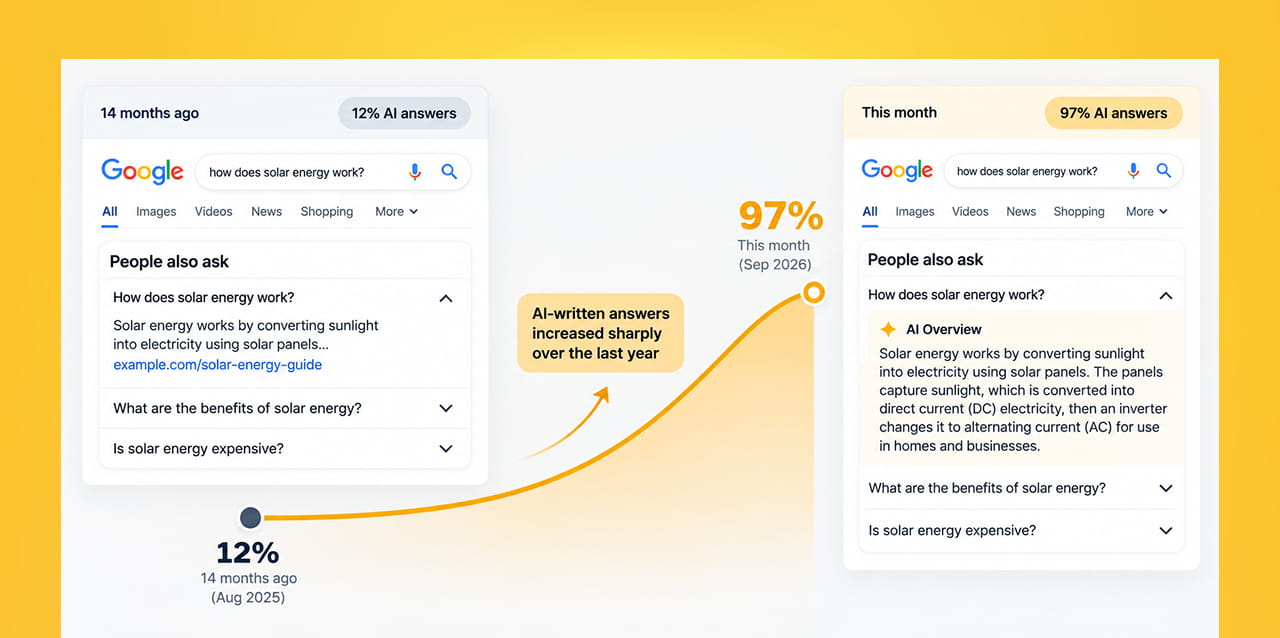
If that sounds technical, here’s the plain-English version: the box that used to give a tiny preview of someone’s webpage now gives a full AI-written answer instead — meaning far fewer people ever need to click through to your website to get what they came for.
Let’s unpack what this actually means for a business trying to get found online.
A Quick Recap: What Was “People Also Ask” Before?
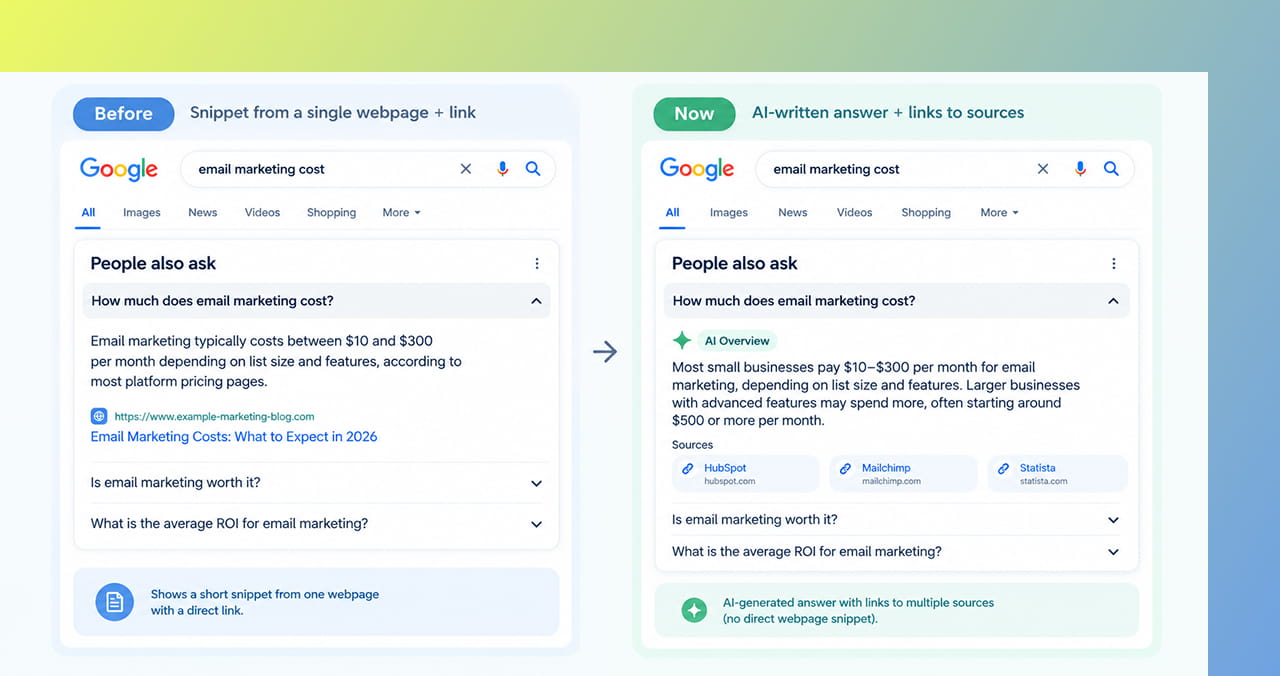
For years, “People also ask” worked like this: Google would show a related question, and when you tapped it, a short snippet of text — usually lifted word-for-word from someone’s actual webpage — would appear, along with a link to that page. If your content was well-written and directly answered a common question, you had a real shot at showing up there and earning a click.
That’s what’s changed. Now, instead of quoting a snippet from one specific page, Google’s AI reads across many sources and writes its own answer on the spot. The links to the original sources are usually still there, tucked away — but the click-worthy, human-written preview is gone, replaced by an AI paraphrase.
Why This Matters More Than It Sounds
A study by Pew Research Center found that people who saw an AI summary clicked a regular search result in just 8% of visits, compared with 15% when no summary appeared
This isn’t an isolated change — it’s part of a much bigger shift. Separate research this year found that AI-generated answers (of which “People also ask” is now essentially one type) show up on close to half of all Google searches, and pages that used to sit in the coveted #1 spot are now seeing noticeably fewer clicks than they used to, simply because people are getting their answer without scrolling any further.
In practical terms:
- Fewer people are clicking through to websites at all, even ones ranking well, because the answer is often satisfied right there on the search page.
- Being “the source Google’s AI trusts” now matters as much as being #1 in the old ranking sense. Your content can influence an AI-written answer without you ever getting credited with a visible click.
- This affects almost every kind of business, because “People also ask” boxes appear across nearly every topic — not just tech or news.
For a proper look at how to structure content so it earns visibility in this new environment, the old approach of “write a page, rank it, get clicks” needs a rethink.
So What Should You Actually Do About It?
The instinct might be to panic, but there’s a clear, practical path here. Since Google’s AI is essentially reading across many good answers and writing its own version, your job shifts slightly: instead of just trying to rank, you’re trying to be the kind of source an AI system would confidently borrow from.
- Answer the question directly, in the first couple of sentences. Don’t bury the actual answer under three paragraphs of introduction — AI systems (and impatient readers) reward pages that get to the point fast.
- Be specific, not vague. “It depends on several factors” doesn’t get quoted. A clear number, a clear yes/no with context, or a clear step-by-step does.
- Cover the follow-up questions too. If someone asks “Is email marketing still worth it?”, the natural next questions are “How much does it cost?” and “How do I get started?” — answering those in the same piece increases your odds of being pulled into more than one AI-generated answer.
- Keep building genuine, well-explained content, even though fewer people will click through. Even when someone doesn’t visit your site, being cited as a source still builds brand recognition and trust over time — and some portion of readers always will click through to learn more.
Why Google AI Overviews Matter More Than They Sound
It’s worth being clear about what this change is not:
- It doesn’t mean SEO or content writing is pointless — if anything, being a genuinely clear, trustworthy source matters more, not less.
- It doesn’t mean every visitor is gone — people with more specific or complex questions, or people who want to verify what they read, still click through.
- It doesn’t mean your existing content is worthless — but content that’s vague, padded, or hard to skim is going to lose out faster than it used to.
Quick Takeaways
- Nearly all “People also ask” answers on Google are now written by AI, not pulled directly from a single webpage.
- This means fewer clicks to websites overall, even for well-ranking pages, because the answer is often satisfied on the search results page itself.
- Getting cited as a trusted source inside an AI answer is becoming as important as ranking #1 used to be.
- The fix is to write clear, specific, front-loaded answers — and to anticipate the natural follow-up questions your readers will have.
- Content strategy in 2026 isn’t dead — it just needs to optimize for being the source an AI trusts, not just for earning a click.
Wondering If Your Content Is Still Getting Found?
If your traffic has quietly dipped even while your rankings look fine, this shift is very likely part of the reason. Reach out through our contact form and we’ll help you rework your content strategy for how people — and AI — actually search today.